- Chapter 1: The Old Shop
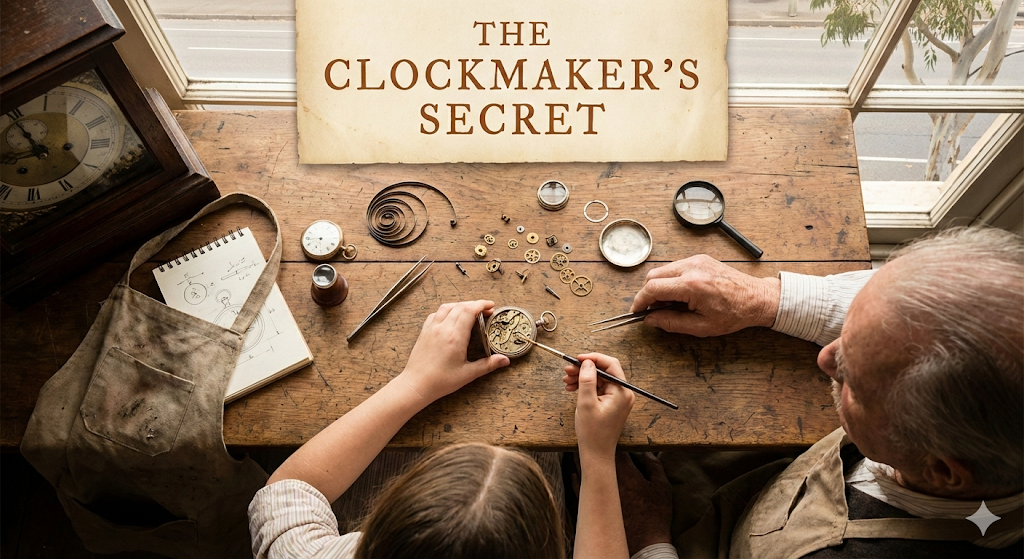
Eliza loved the smell of the dusty, quiet clock shop on the corner of High Street. Mr. Finch, the clockmaker, was a very old man who wore a dusty apron and tiny glasses. He fixed antique clocks and watches. His shop was a museum of ticking, chiming, and whirring mechanisms.
One afternoon, Eliza watched him struggle to lift a heavy grandfather clock. “Careful, Mr. Finch!” she exclaimed. He sighed, “I’m not as young as I used to be, Eliza. I need an apprentice.” Eliza knew she wasn’t strong enough to lift the clocks, but she was good with her hands and loved puzzles.
- Chapter 2: An Unlikely Task
Mr. Finch smiled. “I have a task for you, then. I need a pair of young, sharp eyes.” He led her to a small workbench covered in tiny gears and springs. He pointed to an intricate pocket watch. “This watch belonged to a famous Australian pioneer. It keeps stopping. The problem isn’t the spring, it’s something subtle.”
Eliza was excited. This was a real-life mechanical mystery! Mr. Finch handed her a small magnifying glass and taught her how to gently use the fine tweezers. He warned her that a clockmaker must have immense patience and concentration.
- Chapter 3: The Missing Link
Eliza started examining the pieces. The gears were beautiful, like tiny brass flowers. She checked the balance wheel, the hairspring, and the jewels. Everything looked perfect. Frustration started to creep in. She worked for an hour, the rhythmic tick-tock of the surrounding clocks making her feel sleepy.
She paused, rubbed her eyes, and looked again. Then, she saw it! Right at the edge of the tiny second gear, there was a minute speck of something dark. It wasn’t metal. It looked like a tiny, dried piece of an insect wing, or maybe even a grain of sand, stuck with old oil. It was almost invisible to the naked eye, but it was just enough to interrupt the smooth movement of the gears.
- Chapter 4: The Clockmaker’s Philosophy
Eliza carefully used a single hair from a small brush to dislodge the speck. She reassembled the watch, her hands trembling slightly with concentration. She wound the mainspring. TICK-TOCK, TICK-TOCK, TICK-TOCK. The watch ran perfectly!
Mr. Finch watched her from across the room. He walked over, picked up the watch, and held it to his ear. A wide, gentle smile spread across his face. “Excellent work, Eliza. You have the precision required.” He explained that the tiny speck represented a great lesson.
- Chapter 5: More Than Time
“You see,” Mr. Finch said, “a clock is like life. It’s not the big, dramatic parts that stop it, but the smallest, most insignificant details that get overlooked. The smallest thing can ruin the whole mechanism.”
Eliza felt a wave of understanding. She had solved the mystery by slowing down and paying attention to the truly tiny things. Mr. Finch allowed her to keep the magnifying glass. She now visited the shop every week, not just to watch, but to assist. She was learning that being a clockmaker was less about fixing time, and more about understanding the deep interconnection of tiny parts.
Exercise: Sequencing and Vocabulary
- Order of Events: Which happened first:
- a) Eliza discovered the grain of sand.
- b) Eliza used the magnifying glass and tweezers.
- c) Mr. Finch asked Eliza to be his apprentice.
- Define a Term: What is an apprentice in the context of this story?
- Understanding a Concept: Explain, in your own words, the clockmaker’s philosophy about life and tiny details.